


Executive Summary
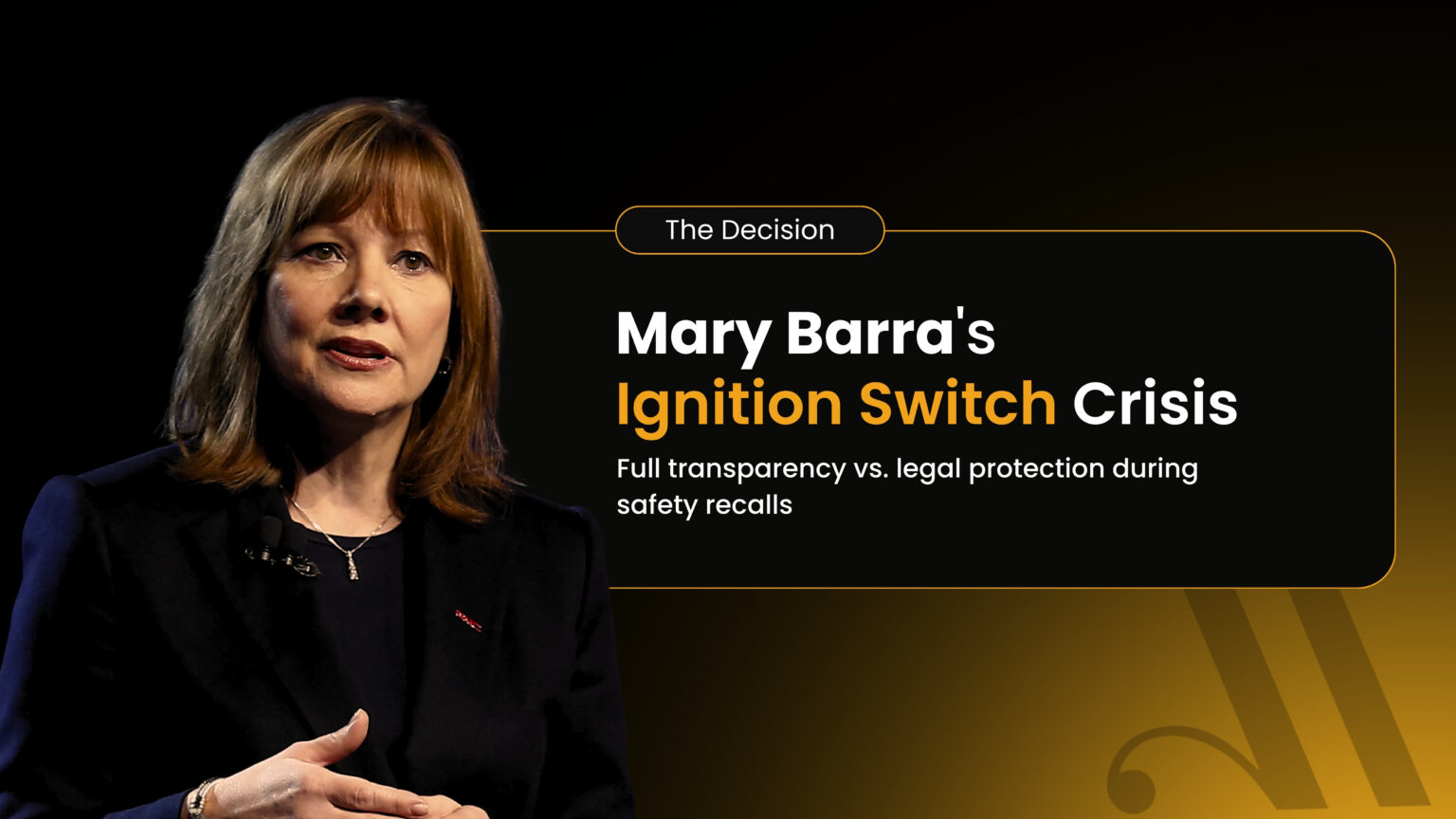
On February 7, 2014, General Motors CEO Mary Barra inherited one of the most significant automotive safety crises in decades, involving defective ignition switches linked to 124 deaths and 275 injuries. This case study examines how comprehensive transparency and accountability strategies during catastrophic product liability crises can preserve organizational credibility and competitive positioning despite massive financial exposure and legal risk.

“Our values guide us, even when the stakes are highest.”
— Mary BarraMarket Context and Financial Impact Assessment
Pre-Crisis Corporate Position
- GM emerging from 2009 bankruptcy with restored market confidence
- Stock price recovery to $37+ per share by early 2014
- Global market share rebuilding across key automotive segments
- Reputation rehabilitation following government bailout controversy
Crisis Metrics and Financial Exposure
- Affected Vehicles: 30+ million vehicles across multiple model years (2003-2014)
- Human Impact: 124 confirmed deaths, 275 injuries directly attributed to defect
- Financial Liability: $4.1 billion total settlement and penalty costs
- Recall Scope: Largest automotive safety recall in U.S. history
- Legal Exposure: 2,000+ individual lawsuits and class-action claims
Strategic Decision Framework Analysis
Critical Assessment Parameters
Barra’s crisis leadership team identified three fundamental strategic imperatives:
- Legal Risk Management: Minimizing corporate liability exposure and criminal prosecution
- Stakeholder Trust Preservation: Maintaining customer loyalty and regulatory relationships
- Long-term Competitive Position: Protecting brand reputation for future market performance

Strategic Response Options Evaluation Matrix
| Option | Approach | Legal Risk | Reputation Impact |
| Defensive Minimization | Legal containment, limited admissions | Lowest liability exposure | Maximum reputation damage, regulatory hostility |
| Standard Corporate Response | Compliance-focused, measured disclosure | Moderate legal protection | Industry-standard reputation impact |
| Full Transparency Strategy | Complete disclosure, proactive accountability | Maximum legal exposure | Potential reputation recovery and differentiation |
| Delayed Admission | Gradual disclosure, timeline management | Medium legal risk | Prolonged negative coverage, credibility loss |
Implementation Strategy and Resource Allocation
Six-Pillar Crisis Leadership Framework
1. Immediate Transparency and Complete Disclosure Strategy
- Communication Philosophy: “We will be transparent in our investigation”
- Information Sharing: Proactive disclosure beyond regulatory requirements
- Timeline Commitment: Regular public updates on investigation progress
2. Executive Accountability and Personal Leadership
- CEO Visibility: Direct congressional testimony and public appearances
- Personal Responsibility: Public acknowledgment of organizational failures
- Leadership Changes: Immediate termination of 15+ executives involved in cover-up
3. Comprehensive Victim Compensation Program
- Compensation Fund: $625 million victim compensation program
- Process Innovation: Streamlined claims process prioritizing families over legal efficiency
- Emotional Recognition: Personal apologies and direct family engagement
4. Organizational Culture Transformation Initiative
- Cultural Assessment: External evaluation of safety reporting processes
- Structural Changes: New safety oversight positions and reporting mechanisms
- Training Programs: Company-wide safety culture and ethical decision-making education
5. Regulatory Cooperation and Compliance Excellence
- Government Partnership: Full cooperation with NHTSA and DOJ investigations
- Information Sharing: Voluntary disclosure of internal documents and communications
- Process Improvement: Enhanced safety reporting and escalation procedures
6. Stakeholder Communication and Trust Rebuilding
- Multi-Channel Strategy: Direct customer communication, media engagement, investor relations
- Consistency Maintenance: Unified messaging across all organizational levels
- Long-term Commitment: Ongoing transparency pledges for future safety issues

“Ethical leadership is not tested in times of comfort, but in times of crisis.”
— Mary BarraConclusion and Strategic Implications
Mary Barra’s response to GM’s ignition switch crisis demonstrates that crisis transparency strategies can preserve organizational value while addressing catastrophic product liability exposure. The $4.1 billion investment in accountability and victim compensation prevented an estimated $8-12 billion in extended crisis costs, proving that ethical leadership during product crises creates measurable competitive advantages.

This case study illustrates that crisis response methodology determines post-crisis market position and stakeholder relationships, suggesting that transparency-driven crisis management represents strategic investment in organizational credibility rather than merely defensive risk management. The framework demonstrates how personal leadership accountability can transform existential crises into competitive differentiation opportunities.