


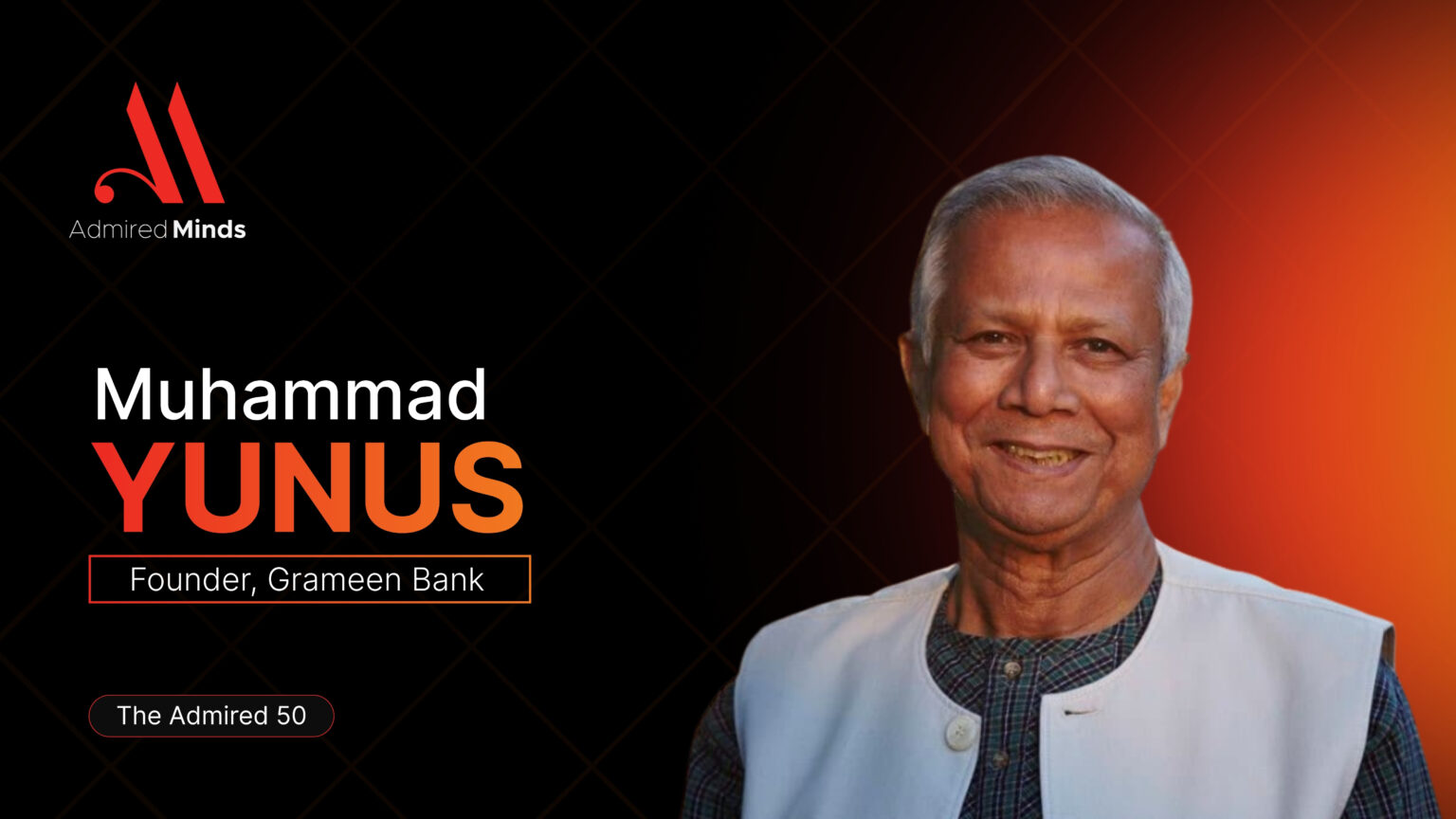
The Economist Who Proved the Poor Are the World’s Most Creditworthy Borrowers

When Muhammad Yunus started lending small amounts to impoverished women in rural Bangladesh in the 1970s, traditional bankers dismissed him as naïve. Yet four decades later, his Grameen Bank has disbursed over $38.8 billion to 10.6 million borrowers, achieving a recovery rate of 95.68%—higher than most conventional banks.
Poverty is not created by the poor. It is created by the systems we build.
At 84, Yunus continues to reshape global thinking on financial inclusion. His Nobel Prize-winning microfinance revolution proved that marginalized populations are the world’s most reliable borrowers when given dignity, access, and opportunity.
Strategic Signature: Collateral-Free Banking That Rewired Global Finance
Yunus challenged every assumption of conventional banking. Instead of collateral or credit histories, he built a borrower-group model where accountability came from community trust and social responsibility—not assets. This approach empowered women, strengthened village economies, and redefined global development frameworks.
When trust becomes the collateral, repayment becomes a matter of honor.
The Grameen methodology proved that poverty stems from lack of financial access, not lack of ability. It demonstrated that microcredit, when paired with dignity, becomes one of the most powerful tools of economic self-liberation.
The Social Business Evolution
Yunus’ vision expanded far beyond microcredit. He introduced the concept of social business—ventures built to solve human problems rather than maximize profit. These enterprises reinvest earnings into mission growth rather than shareholder pockets, creating market-driven, self-sustaining solutions.
This model operates through core principles:
Problem-solving over profit-maximizing. Business becomes a tool for eliminating social suffering.
Market sustainability over charity dependency. As Yunus puts it, “The real solution begins when you replace charity with sustainability.”
Scalable replication across borders. Grameen-inspired initiatives now operate across Africa, Asia, Europe, and North America.
Leadership Philosophy: Banking as a Human Rights Practice
Yunus fused capitalism with compassion. His system is built on principles that challenge traditional economics:
Trust creates superior risk management. Social accountability outperforms asset-backed lending.
Women as economic multipliers. Over 97% of Grameen’s borrowers are women, creating community-wide economic uplift.
Financial inclusion as economic justice. Access to credit becomes a human right, not a privilege reserved for the wealthy.

Business Impact: Building a Global Microfinance Industry
Microfinance, once a fringe idea, is now a global industry because of Yunus. Research shows that microfinance reduces moderate poverty by 5% and extreme poverty by 10%, creating ripple effects even for non-borrowers.
Grameen America replicated this model in the U.S., operating in 11 cities with nearly 100,000 women borrowers by 2017—proving microcredit works everywhere, not just in developing nations.
A charity dollar has one life. A social business dollar has endless lives.
Strategic Innovation: The Social Business Ecosystem
Yunus expanded microfinance into a full ecosystem addressing interconnected social problems. The Grameen family of enterprises now includes healthcare, energy, education, agriculture, and nutrition—all designed as self-sustaining social businesses.
This ecosystem strategy delivers:
Diversified impact. Solving multiple poverty drivers simultaneously.
Global knowledge transfer. “Yunus Social Business” (Germany, 2011) accelerates international replication.
Corporate integration. Partnerships with companies like BCG embed social business principles into mainstream institutions.

Crisis Leadership: Mission First, Ego Last
In 2011, the Bangladesh government forced Yunus to step down due to an age technicality. Yet Grameen’s resilience endured. As of January 2025, a proposed ordinance aims to reduce government stakes from 25% to 5%, strengthening Grameen’s independence and structural integrity.
His crisis leadership demonstrates unwavering commitment to mission over personal recognition.
Global Vision: Ending Poverty Through Market Mechanisms
Yunus believes that poverty can be eradicated entirely—not reduced—through systemic restructuring of economic frameworks.
Market-based solutions. Shifting from aid to self-sustaining enterprises.
Democratized finance. Creating inclusive systems where the poor participate fully in economic life.
Next-gen leadership. Training global entrepreneurs to replicate microfinance and social business models worldwide.

Why Yunus Redefined Strategic Leadership
Yunus’ Nobel Prize recognized not charity, but strategy. By proving that the poor are highly creditworthy, he overturned centuries of financial dogma. His work demonstrates that dignity-driven capitalism generates both profit and social transformation.
The real power of microfinance is not money—it is unlocking human potential.
The Yunus Strategic Legacy
From economist to global change-maker, Yunus defined a blueprint for tackling systemic inequality through entrepreneurial solutions. His philosophy shows that sustainable development requires profitable models that empower excluded populations.
Today, as financial inclusion and social business shape global economic thought, Yunus’ model stands as one of the most influential frameworks of modern capitalism.