
The Investment Giant Who Made ESG a $10 Trillion Market Force
When Laurence Fink declared that “climate risk is investment risk” in his 2020 CEO letter, many dismissed it as symbolic rhetoric. Five years later, his persistent ESG advocacy has reshaped global capital allocation, proving that environmental, social, and governance priorities strengthen competitiveness rather than limit investment freedom.
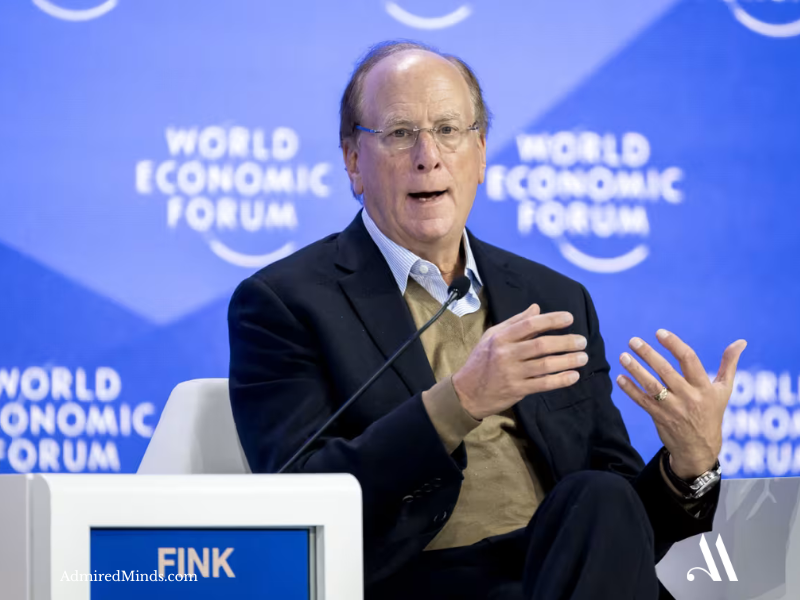
At 72, Fink commands more financial influence than entire governments through BlackRock’s $10+ trillion AUM. His evolution from ESG pioneer to energy pragmatist reflects a leader who adapts messaging to political climates while maintaining long-term sustainability commitments.
“Climate risk is investment risk — and ignoring it is a financial failure, not a political statement.”
Strategic Signature: The Annual Letter That Moves Markets
Fink realized early that BlackRock’s historic scale created not just opportunity but obligation. His annual letters — widely read, heavily analyzed — became tools shaping global corporate governance. His framing of ESG as fiduciary responsibility compelled companies to evolve or be left behind.
His letters drove worldwide adoption of sustainable governance with influential lines like “It is not woke. It is capitalism.”
The Stakeholder Capitalism Revolution
Fink’s greatest ideological contribution is reframing capitalism around stakeholder value. Sustainability, for him, is not morality — it is financial logic. His model integrates ESG into:

• ESG integration as risk management. ESG factors are investment fundamentals, not side metrics.
• Corporate engagement as competitive advantage. BlackRock uses its shareholder power to influence performance.
• Long-term value over quarterly pressure. Purpose-driven companies outperform.
“Sustainability is not a niche. It is the backbone of long-term economic resilience.”
Leadership Philosophy: Financial Power as Responsibility
Fink argues that BlackRock’s scale creates a duty: when your decisions move markets, your responsibility extends beyond returns to global economic stability. His worldview challenges the traditional definition of fiduciary duty.
Fiduciary duty must include environmental and social considerations. Risks affecting society affect portfolios.
Market power must drive positive impact. Influence cannot be neutral.
Stakeholder engagement is investment strategy. Investors demand better corporate governance.
Transforming Global Capital Allocation
Fink’s influence reshaped how institutions direct capital into sustainable assets, causing measurable market shifts. Critics argue he used BlackRock’s vast power to pressure companies — but Fink maintains it is simply long-horizon risk management.
Strategic Innovation: The Energy Pragmatism Evolution
Facing political backlash, Fink shifted language — not principles. “ESG” became “energy pragmatism,” maintaining climate-focused investment strategy while neutralizing political attacks.
Crisis Leadership: Navigating ESG Politicization
Fink’s response to attacks emphasizes adaptation, not retreat. He reframed ESG as long-term financial discipline while cooling political rhetoric. This protected BlackRock’s global market position.
“Principles must remain constant — language can evolve. Strategy survives through adaptation.”
Global Vision: Capital Markets as Transformation Engines
Fink argues that capital markets, not governments, shape humanity’s long-term future. Expanding access to investing, improving retirement systems, and directing capital toward resilient sectors form his broader global mission.
Why Fink Redefined Strategic Leadership
Fink proved that modern leadership requires balancing fiduciary duty with sustainable societal impact. ESG, when executed systematically, enhances financial performance rather than limiting it.
The Fink Strategic Legacy
Under Fink, BlackRock became not just an asset manager but a global governance force. His framework demonstrates that sustainability and profitability align when viewed through a long-term lens.