


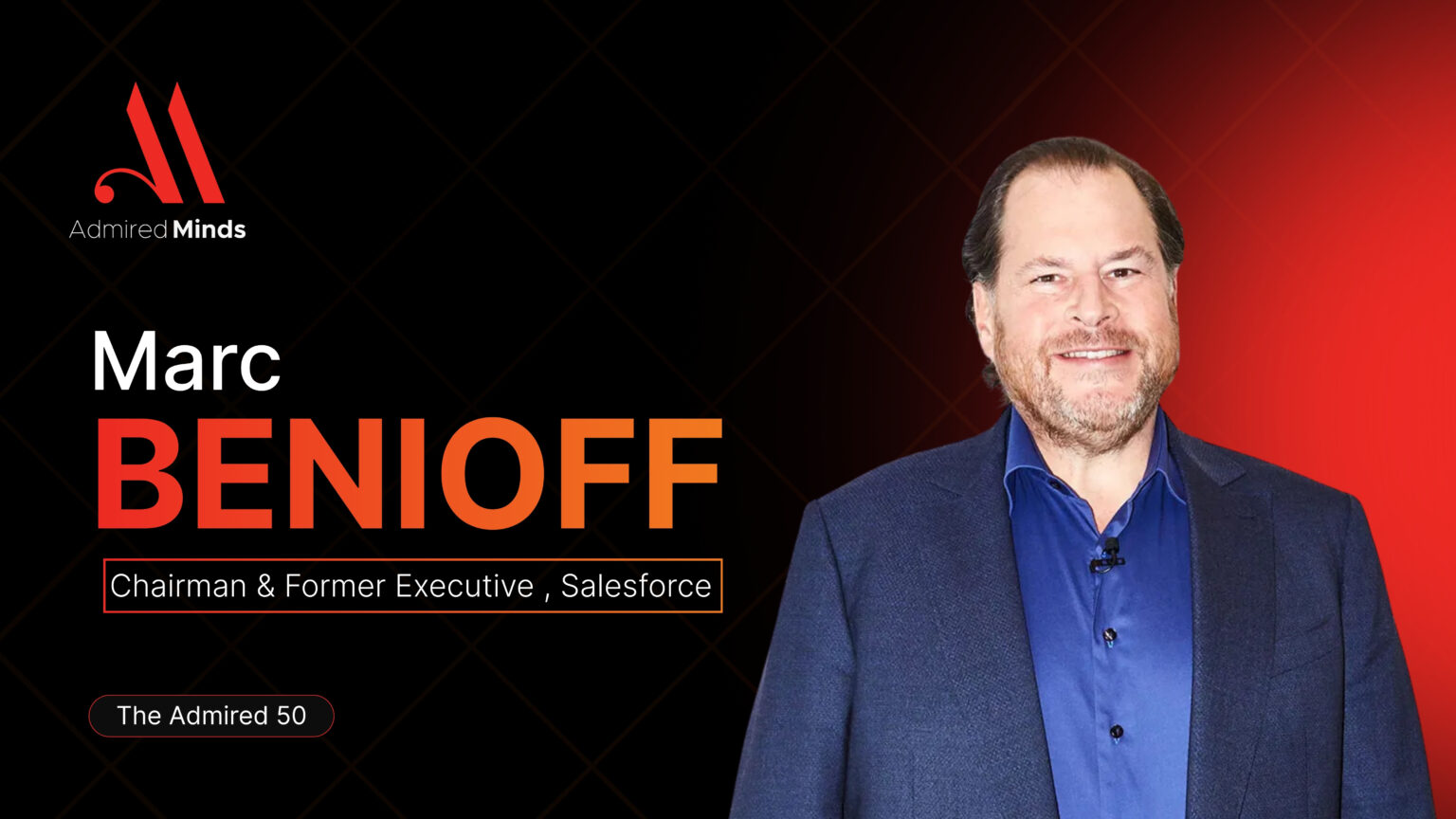
The CEO Who Made Social Justice a Competitive Advantage
When Marc Benioff speaks at corporate events, Fortune 500 CEOs lean forward. Not because of Salesforce’s $300+ billion market cap, but because Benioff figured out what most executives still struggle with: how to make doing good profitable at scale.
“Great CEOs don’t compete only in markets — they compete in values.”
For over two decades, Benioff has proven that stakeholder capitalism isn’t just ethical theater. It’s strategic warfare. While competitors focused on quarterly earnings, he built the world’s most successful CRM platform by treating social responsibility as core business infrastructure.

Strategic Signature: The 1-1-1 Model That Redefined Corporate Purpose
In 1999, before Salesforce even launched, Benioff made a decision Silicon Valley called naive. He adopted the 1-1-1 model: 1% of equity, 1% of employee time, and 1% of products donated to social causes. Critics predicted this “philanthropy tax” would handicap Salesforce.
They were spectacularly wrong.
The 1-1-1 framework became Salesforce’s secret weapon for talent acquisition, customer loyalty, and global market differentiation. Benioff proved that profitability and philanthropy don‚Äôt compete ‚Äî they compound each other.
“Purpose isn’t a cost — it’s a multiplier.”
Today, more than 15,000 companies have adopted variations of this model through Pledge 1%, a movement he co-founded in 2014.
Building the Stakeholder Capitalism Movement
Benioff champions stakeholder capitalism: creating value for customers, employees, shareholders, communities, and the planet. This philosophy drives Salesforce’s AI development, hiring, and acquisition strategy.
The genius lies in execution. Every employee begins their Salesforce journey with community service. Benioff didn’t add social impact to Salesforce — he engineered the company around it.
“A company’s values don’t sit on a wall — they live in its decisions.”
Leadership Philosophy: Trust as the Ultimate Business Strategy
Benioff insists that trust is Salesforce’s highest value — not a slogan, but a competitive moat. This is powerful positioning in a world where software products look increasingly similar.

His leadership framework rests on three principles:
Business as a platform for change. Companies have resources and influence governments lack.
Stakeholder value creates shareholder value. Loyal customers, happy employees, and sustainable operations all drive long-term profit.
Principled leadership during crises. Whether challenging discriminatory laws or supporting employee rights, Benioff uses corporate power strategically.
Business Impact: Transforming Corporate America’s Social Contract
Benioff’s influence extends far beyond Salesforce’s numbers. His advocacy fundamentally shifted how corporations approach social responsibility.
In 2025, Salesforce provided nearly $36 million in education grants, reaching 14 million students. But the deeper transformation is systemic.
In 2019, the Business Roundtable publicly rejected shareholder primacy — a direct reflection of Benioff’s leadership influence.
“Leadership isn’t measured in revenue — it’s measured in responsibility.”
Strategic Innovation: AI Ethics as Competitive Moat
While competitors rushed AI products to market, Benioff prioritized responsible development. Salesforce’s Office of Ethical and Humane Use established guidelines for safe AI.
This long-term discipline paid off. AI now handles half of Salesforce customer interactions, reducing support costs by 17% — while maintaining trust competitors often lose.
Crisis Leadership: Turning Social Issues into Business Strategy
Benioff uses crises as strategic leverage:
Pay equity. Millions invested to close pay gaps increased retention and reduced legal risks.
Climate commitments. Salesforce achieved net-zero emissions across its full value chain.
Social justice action. Benioff invested in Black-owned businesses, HBCUs, and racial justice programs.

Global Vision: Exporting Stakeholder Capitalism
Salesforce operates in over 100 countries, extending Benioff’s philosophy globally. Key areas include:
Education democratization. Free AI courses worldwide.
Healthcare access. Over $250 million donated to children’s hospitals.
Economic development. Pledge 1% helps companies embed stakeholder models.
The Benioff Strategic Legacy
Benioff proved that stakeholder capitalism produces superior returns while delivering measurable social benefits. His 25-year record shows that purpose is not a burden — it is a competitive accelerator.
Why Benioff Redefined Strategic Leadership
His genius lies in recognizing that modern markets reward companies that align profit with purpose. By embedding trust, ethics, and social good into Salesforce’s foundation, he created advantages competitors cannot imitate.

In an era where corporate purpose defines long-term success, Benioff’s model stands as one of the most powerful strategic blueprints of modern capitalism.